
How air springs work.
The range of functions of a full air suspension system far exceeds the capabilities of standard or auxiliary suspension systems. Find out more about how our systems work here.

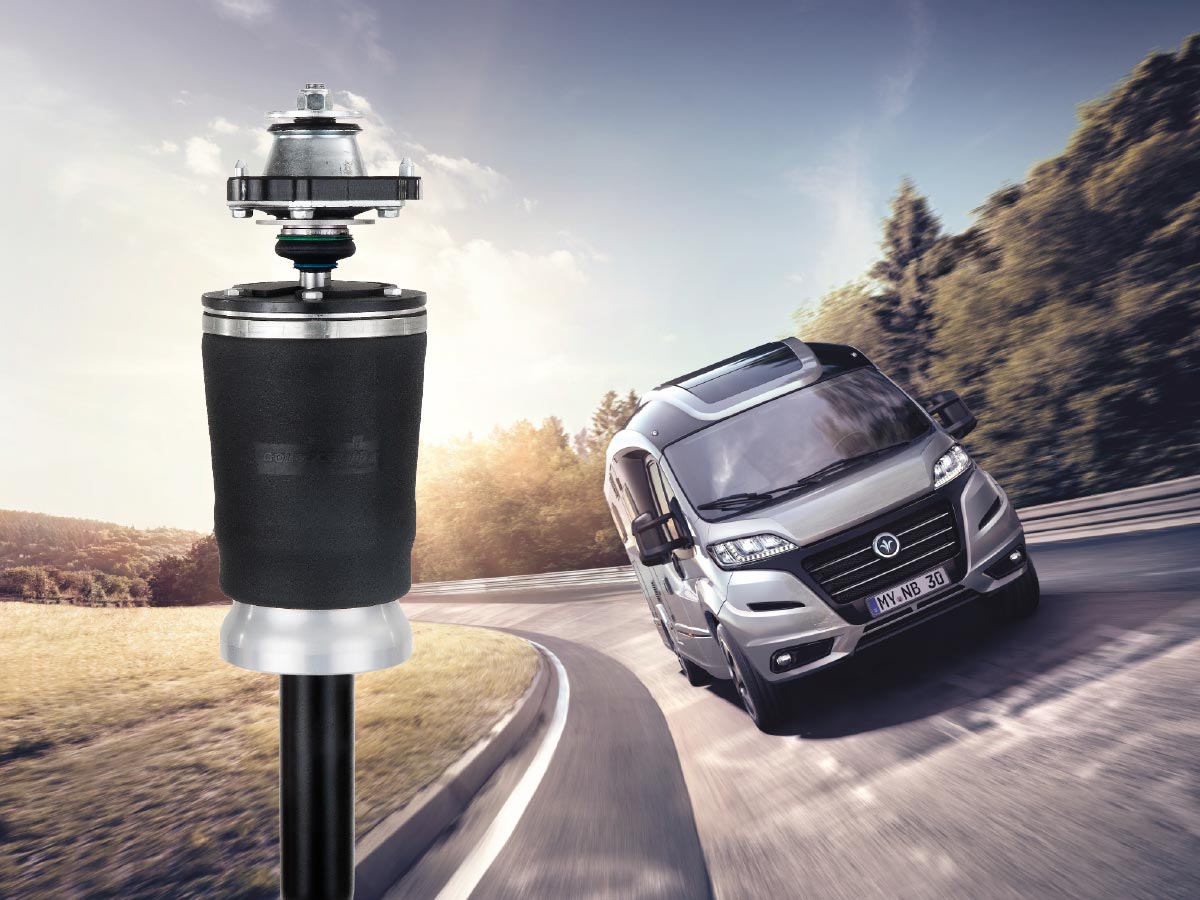
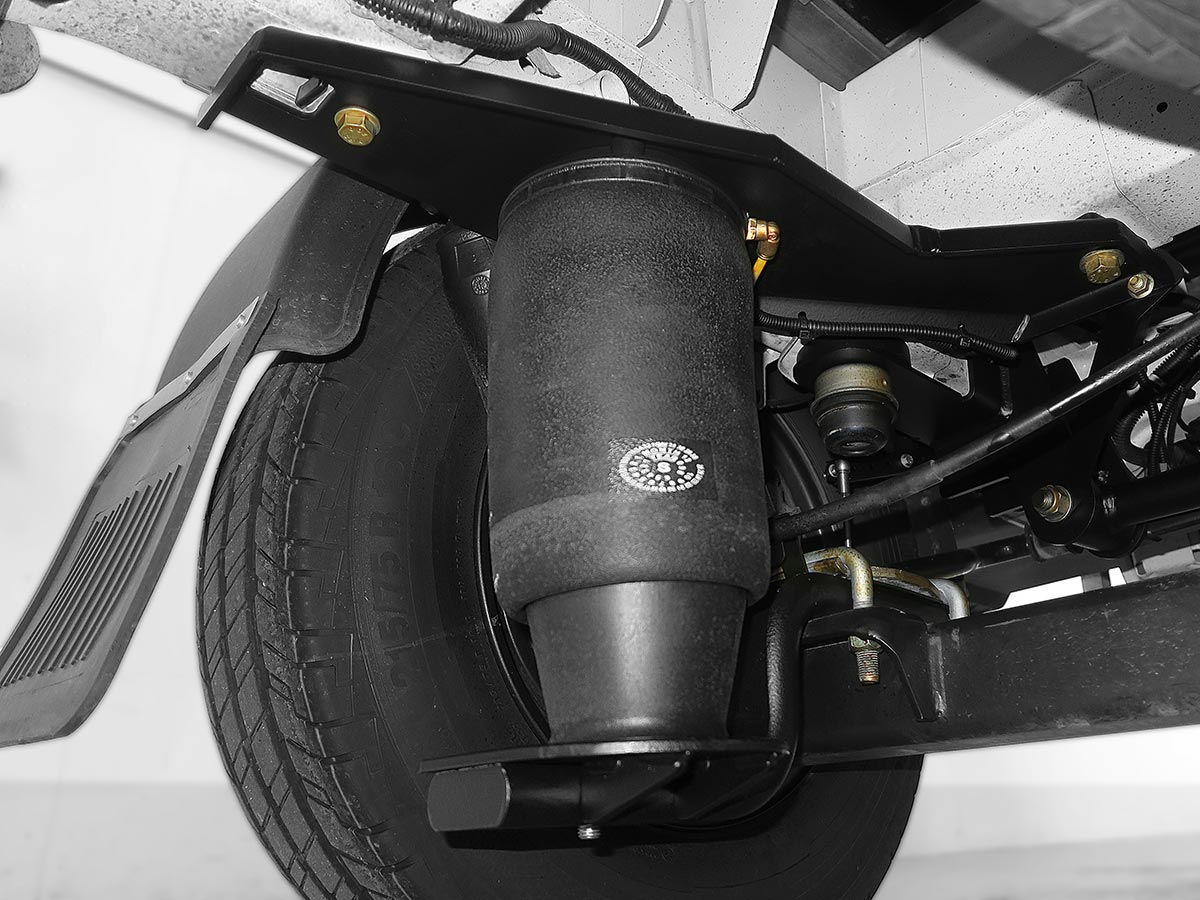
Goldschmitt full air suspension systems replace — depending on the vehicle type and configuration — conventional steel springs entirely with large-volume air bellows. These support the vehicle body and simultaneously handle both the suspension and the active regulation of the chassis. Unlike conventional spring solutions, the spring force is not constant but is dynamically controlled via air pressure. This allows the system to continuously adapt to different load conditions, driving situations, and road conditions. Particularly in motorhomes and special-purpose vehicles with high or variable loads, this delivers noticeable advantages: reduced body roll, improved tracking stability, and an overall more controlled driving behaviour — even in crosswinds or sudden evasive manoeuvres.

Rear axle comfort or full chassis?
Goldschmitt full air suspension systems are available — depending on the vehicle type — as 2-channel or 4-channel solutions. The key difference lies in the number of axles on which the suspension operates, and thus in the number of controllable air circuits. A 2-channel system is typically used on one axle — usually the rear axle. The left and right air bellows are controlled separately, ensuring that even one-sided rear loads are reliably compensated. The separate air circuits also prevent air from flowing from one side to the other during one-sided compression or cornering — a clear advantage for stability and driving behaviour. A 4-channel system, on the other hand, operates on both the front and rear axles and controls each wheel individually. This allows wheel loads to be balanced even more precisely and the chassis balance to be optimally managed. As a general rule: the more controllable air circuits available, the more differentiated the driving behaviour can be adjusted.
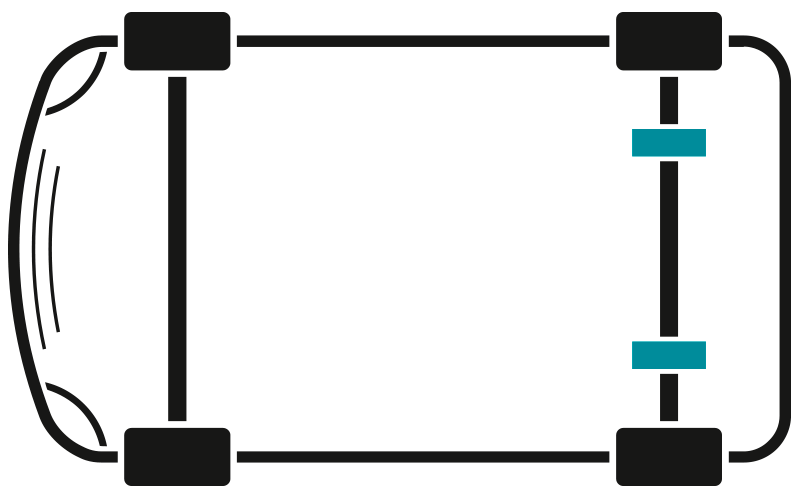
The 2-channel system is equipped with two level sensors. These maintain a consistent ride height at the rear axle.
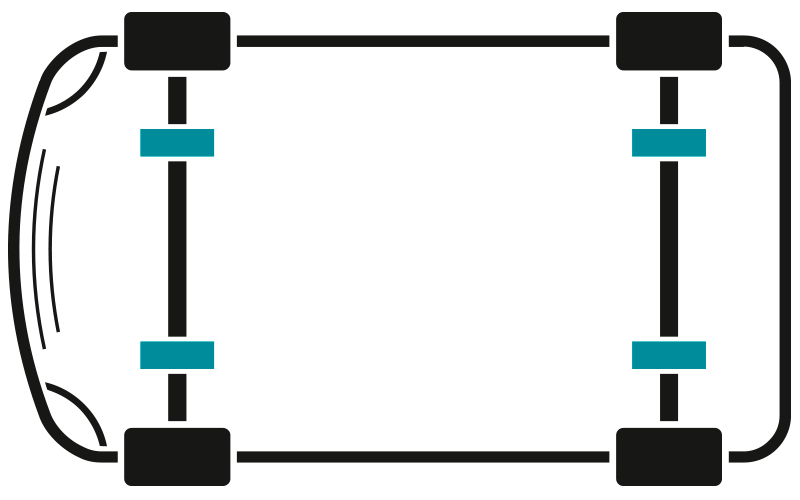
The 4-channel system uses a total of four level sensors. These maintain a consistent ride height at both the front and rear axles.
Load up, get in, drive off.
A central element of how our full air suspension systems work is the automatic level control. It keeps the vehicle at a defined height regardless of the load. Precise sensors continuously measure the distance between the axle and the vehicle body. If this distance changes — for example due to luggage, bicycles, or water tanks — the system automatically adjusts the air pressure in the air bellows. This keeps the ride height constant and the vehicle in optimal operating condition at all times. The continuous adjustment of air pressure ensures that the system responds not only to static loads, but also to dynamic driving influences. Pitching and rolling movements are reduced, and driving behaviour becomes calmer and more predictable. The advantage is particularly evident in vehicles with a high body or a long wheelbase: the chassis stabilises the vehicle without compromising comfort, providing a safe and harmonious driving experience.

Practical controls and comfort features.
In addition to automatic level control, our full air suspension systems offer additional control options for adjusting the vehicle height. The vehicle can be lowered for loading or unloading, or deliberately raised for specific driving situations, with manual control allowing individual adjustments at any time. On 4-channel systems, additional functions are also available, such as Sport Mode — which slightly lowers the ride height and improves aerodynamics — as well as the Auto-Level function for levelling the vehicle at a standstill at the touch of a button. An integrated weighing function allows the weight at the air-suspended axles to be determined.
More payload thanks to air suspension.
Many customers value our full air suspension systems not only as a comfortable and safe chassis, but also as an ideal basis for a subsequent Payload Upgrade of their vehicle. We are happy to check whether a payload upgrade is possible for your vehicle model and will support you through all the necessary steps — from planning to implementation. In addition to the chassis, the load capacity of the tyres and wheels also plays a central role. Should your current wheels not meet the required load rating, we offer high-quality, high-load-capacity Alloy Wheels — ideally suited for vehicles whose payload potential is to be extended.