
The stages of a load increase.
How expert reports, suspension adjustments, and registration result in a weight increase that is legally sound and functions reliably in everyday use.

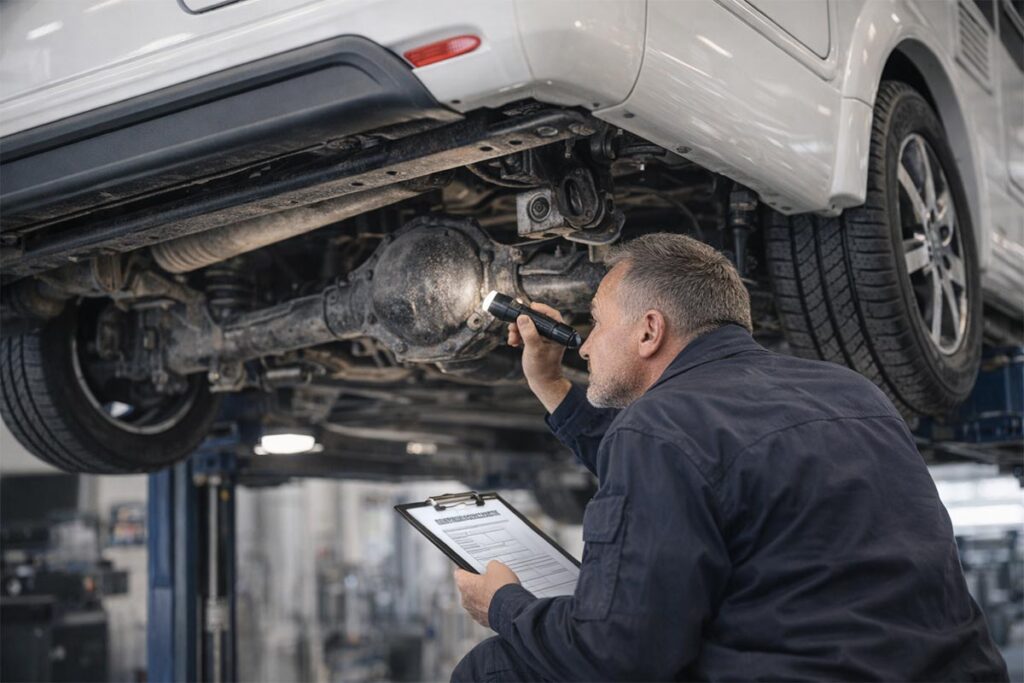
From suspension to registration—everything from a single source.
Professional load capacity enhancement is much more than a simple adjustment of the suspension and chassis. It follows a structured technical process that ensures a vehicle is not only legally permitted to carry higher loads after the modification but also remains stable, safe, and comfortable under real-world conditions. The foundation of every load-capacity increase is a load-capacity assessment tailored to the specific vehicle model, which defines the permissible axle loads, component requirements, and legal framework. Based on this, a precise selection of suitable chassis components is made—components that are technically sound and acceptable in terms of driving dynamics. This systematic approach guarantees that the new payload capacity is not just theoretical but can actually be utilized—without compromising the vehicle’s handling characteristics, braking performance, or stability. Especially for motorhomes, vans, or commercial vehicles, which quickly reach their gross vehicle weight rating due to extensive equipment and accessories, a well-planned payload increase forms the foundation for safe and stress-free daily travel.
1. Checking Availability and Initial Condition
The first step in any weight increase project is determining whether the vehicle model in question can technically be upgraded at all. To do this, we check whether a corresponding weight increase report is available, assess the vehicle’s current condition, and determine which suspension components are available. A Goldschmitt weight increase is always based on a thorough technical weight increase report that specifies the axle loads and gross vehicle weight to which the vehicle can be increased, as well as the suspension modifications required to achieve this. For a precise assessment, the vehicle registration certificate and, if applicable, the COC documents are usually sufficient. The decisive factor here is not only the gross vehicle weight rating but also its distribution between the front and rear axles—because a higher total mass is of little use if, in practice, one of the axles reaches its load limit prematurely. This analysis forms the basis for all further steps. It ensures that every planned modification is technically sound, reliable, and legally compliant, and that the vehicle can be operated safely even under real-world loading conditions.
2. Spring reinforcement—the key step toward increasing payload capacity
In most cases, reinforcing the suspension is the key step toward safely increasing axle loads and the gross vehicle weight rating. Depending on the vehicle model and specific application, reinforced coil springs are used on the front axle, while the rear axle may be equipped with additional leaf springs, coil springs, or air suspension systems. For maximum flexibility and comfort, innovative full-air suspension systems can also be installed. Depending on your budget and intended use, we recommend the appropriate components, which not only improve driving dynamics but also increase structural reserves. A professionally designed suspension reinforcement ensures that the vehicle remains stable, comfortable, and safe on the road even when fully loaded—for reliable use in everyday driving, on long trips, or during demanding operations.
3. Wheel-Tire Combination – The Cornerstone of Load Capacity
Nicht jedes Fahrzeug lässt sich allein über die Federung auflasten. Häufig reichen die serienmäßigen Räder und Felgen nicht aus, um höhere Lasten zuverlässig und sicher zu tragen. Deshalb spielt die Rad‑Reifen-Kombination eine zentrale Rolle bei jeder Nutzlasterhöhung. Unser Produktportfolio umfasst hochwertige Aluminiumfelgen mit besonders hoher Tragkraft, die speziell für erhöhte Achslasten entwickelt wurden. Sie erfüllen nicht nur die technischen Anforderungen, sondern sind auch rechtlich für die geplante Auflastung zugelassen. In Kombination mit der passenden Bereifung gewährleisten sie, dass die zusätzlichen Lasten sicher übertragen werden und das Fahrzeug stabil und berechenbar bleibt. Erst das harmonische Zusammenspiel aus verstärkter Federung und hochtragfähigen Rädern bildet ein robustes Fundament für eine sichere, zuverlässige und dauerhafte Nutzlasterhöhung – für mehr Sicherheit, Fahrkomfort und eine längere Lebensdauer Ihres Fahrzeugs.
Not every vehicle can be upgraded for higher loads using suspension alone. Often, the standard wheels and rims are not sufficient to carry heavier loads reliably and safely. That is why the wheel-tire combination plays a central role in any payload increase. Our product portfolio includes high-quality alloy wheels with exceptionally high load-carrying capacity, specifically designed for increased axle loads. They not only meet the technical requirements but are also legally approved for the planned load increase. In combination with the appropriate tires, they ensure that the additional loads are safely transferred and that the vehicle remains stable and predictable. Only the harmonious interplay of reinforced suspension and high-load-capacity wheels creates a robust foundation for a safe, reliable, and long-lasting payload increase—for greater safety, driving comfort, and a longer service life for your vehicle.
4. Acceptance and Registration – Legal Completion
Eine Auflastung ist erst dann vollständig, wenn alle Maßnahmen offiziell geprüft und in die Fahrzeugpapiere eingetragen wurden. Nach der fachgerechten Montage kontrolliert eine unabhängige Prüforganisation – wie TÜV oder DEKRA – das Fahrzeug und überprüft die Übereinstimmung mit dem entsprechenden Teile- oder Auflastgutachten. Der Prüfer bestätigt die erfolgten technischen Änderungen und stellt eine offizielle Bescheinigung aus. Mit diesem Dokument erfolgt der abschließende Schritt: die Eintragung der neuen Achslasten und des erhöhten zulässigen Gesamtgewichts bei der zuständigen Zulassungsstelle. Erst danach darf das Fahrzeug die neuen Werte rechtlich nutzen. Dieser formale Abschluss ist ein entscheidender Bestandteil jeder Auflastung. Er gewährleistet, dass Reisemobilfahrer sowie Betreiber von Nutzfahrzeugen jederzeit gesetzeskonform unterwegs sind und gleichzeitig sicher im Alltag fahren – mit der Gewissheit, dass alle technischen Anpassungen geprüft, dokumentiert und offiziell freigegeben wurden. Für die komplette Nutz- und Achslasterhöhung inklusive fachgerechter Montage der Fahrwerkskomponenten stehen Ihnen unsere Experten in den Goldschmitt Technik‑Centern in Walldürn, Polch und Leutkirch zur Verfügung. Nach der Montage wird hier auch direkt die Abnahme durch den TÜV vorgenommen – so erhalten Sie alles aus einer Hand.
A load increase is not complete until all modifications have been officially inspected and recorded in the vehicle’s registration documents. After proper installation, an independent inspection agency—such as TÜV or DEKRA—inspects the vehicle and verifies that it complies with the relevant parts or load increase certification. The inspector confirms the technical modifications that have been made and issues an official certificate. This document serves as the final step: the registration of the new axle loads and the increased gross vehicle weight with the relevant registration office. Only then is the vehicle legally permitted to operate with the new specifications. This formal completion is a crucial part of any load-increase modification. It ensures that motorhome drivers and commercial vehicle operators remain in compliance with the law at all times while driving safely in everyday use—with the assurance that all technical modifications have been inspected, documented, and officially approved. Our experts at the Goldschmitt Technik Centers in Walldürn, Polch, and Leutkirch are available to assist you with the complete load and axle load increase, including professional installation of the chassis components. After installation, the TÜV inspection is also conducted directly on-site—so you get everything from a single source.