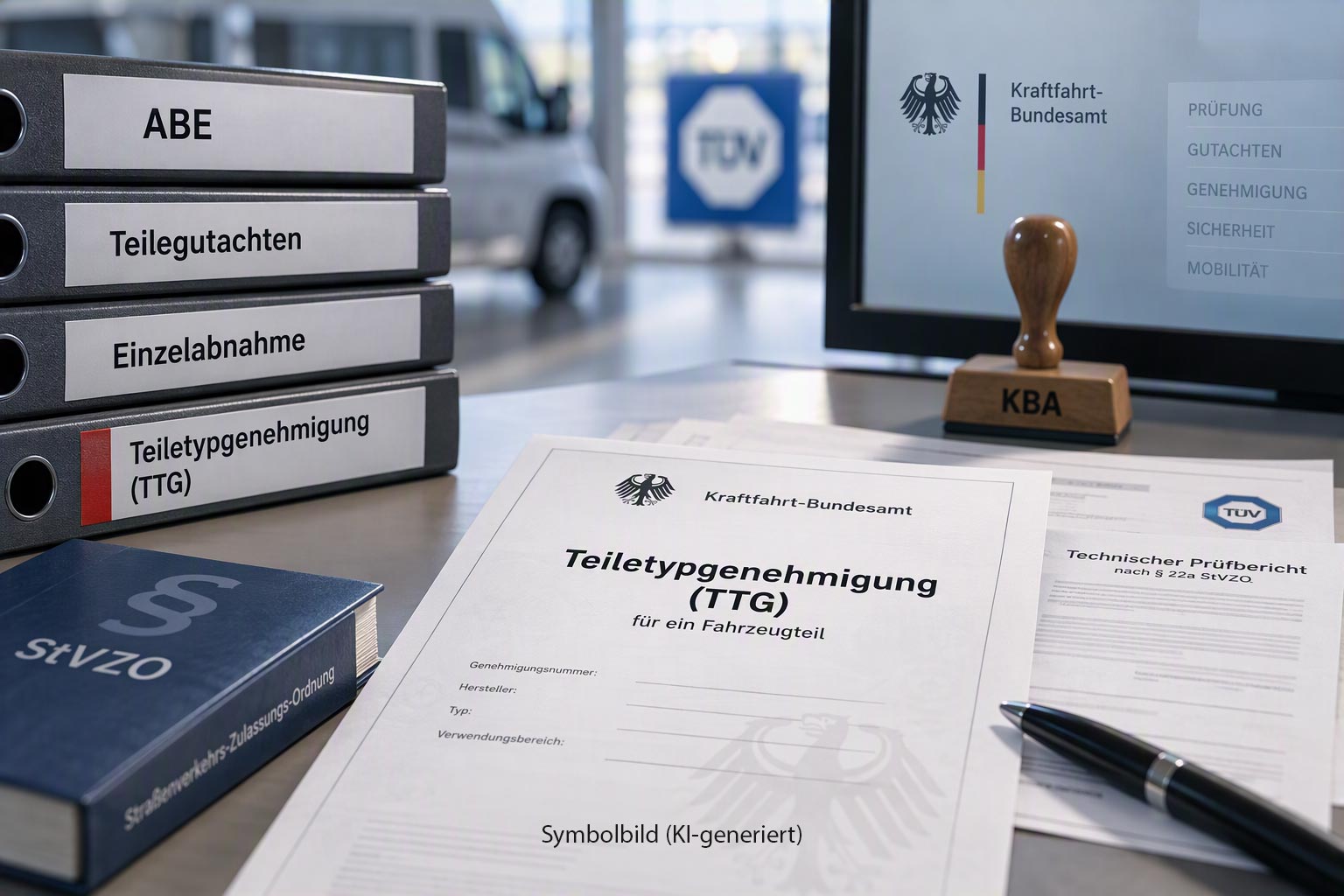
Anyone involved with suspension optimizations, suspension components, or vehicle payload upgrades will sooner or later encounter terms such as ABE (General Operating Permit), Teilegutachten (parts certificate), Einzelabnahme (individual inspection/approval), or Teiletypgenehmigung (TTG – component type approval). As of June 20, 2025, new regulatory frameworks for the approval of vehicle parts have come into effect in Germany. For vehicle owners, this transition is barely noticeable at first glance; however, for manufacturers and providers of technical vehicle solutions, a great deal has changed. Since we frequently receive questions on this subject, we would like to briefly explain the background.
Why do vehicle parts require approval in the first place?
Technical modifications to a vehicle must not compromise road safety. For this reason, many vehicle components must be tested and approved before they can be used. This applies, for example, to suspension components, air suspension systems, wheel rims, or increases in a vehicle’s permitted gross weight. The relevant approval documentation ensures that a product has been tested for specific vehicle types and is permitted for use under defined conditions.
ABE, parts certificate, and individual approval – what is the difference?
For many years, there have been various ways to legally use vehicle parts on public roads. The required procedure depended on factors such as the type of component, the specific vehicle model, and the extent of the technical modification. Key forms of approval and inspection included the ABE (general operating permit), the parts certificate (Teilegutachten), and the individual vehicle inspection (Einzelabnahme).
ABE (General Operating Permit): An ABE is issued by the Federal Motor Transport Authority (Kraftfahrt-Bundesamt) and applies to precisely defined applications. Depending on the product, this may eliminate the need for further official registrations or inspections. As a general rule, the ABE document must be kept in the vehicle and presented upon request. This requirement does not apply if the modification—including any associated restrictions or conditions—has been fully entered into the vehicle registration document (Part I).
Parts certificate (Teilegutachten): For a long time, the parts certificate was the standard procedure for numerous vehicle modifications. It involved having a component tested by a technical service provider, which would then issue a corresponding certificate. This documentation served as the basis for obtaining the necessary official approvals and vehicle registration entries. Goldschmitt’s suspension products also come with the relevant approval documentation, ensuring compliance with all applicable legal and road traffic regulations.
Individual vehicle inspection: In the case of custom vehicle modifications, unique vehicle configurations, or situations where neither a general operating permit (ABE) nor relevant technical reports are available, an individual vehicle inspection may be required. During this process, an expert assesses the specific vehicle—including any modifications made—and verifies whether it meets all applicable legal and technical requirements. At Goldschmitt, however, this procedure is only used in rare, exceptional cases.
What has changed since June 20, 2025?
As of June 20, 2025, new Teilegutachten (component certificates) are no longer being issued. They have been replaced by what is known as a Teiletypgenehmigung (TTG – component type approval). Technical assessments continue to be conducted by a designated technical service. The resulting test reports serve as proof of technical suitability and form the basis for the subsequent approval process. However, the actual approval is now granted by the Kraftfahrt-Bundesamt (KBA – Federal Motor Transport Authority). Consequently, additional procedural steps, tests, and documentation requirements have been introduced.
Why does this also affect existing products?
Although many products have already been successfully on the market for years, the new approval procedure entails a significant additional workload. This is because the new process applies not only to new products and increases in payload capacity, but also requires that numerous existing technical reports be gradually transitioned into the new regulatory framework. This is particularly relevant in the case of payload increases. Since a payload increase relies on the interaction of various chassis components, it is not enough to simply convert the primary payload-increase report into a component type approval; the reports for the individual chassis components used must also first be updated to meet the new approval requirements. Only once this foundation is established can the payload increase itself be approved. Consequently, this creates a substantial additional burden in terms of technical testing, documentation, and coordination with regulatory authorities.
Why do some payload increases take longer nowadays?
The technical development of a product is often only one part of the journey toward its market launch. Today, significantly more approval steps must be completed than was the case just a few years ago. At the same time, existing products and expert assessments are being adapted to meet new requirements. While this process consumes substantial personnel and organizational resources, it is essential for ensuring that legally compliant solutions can be offered in the long term. Consequently, some areas may currently experience longer processing and approval times, even though the technical feasibility has already been demonstrated.
What does this mean for Goldschmitt?
We are currently working intensively on developing new products that meet current approval requirements, while simultaneously transitioning several hundred existing product and load-capacity certification reports into the new approval process. In doing so, we are in close communication with the relevant technical services and regulatory authorities. Even under these new framework conditions, our goal remains to provide technically sophisticated, safe, and legally compliant solutions for motorhomes, vans, and commercial vehicles.