Powerful Components.
The carefully coordinated components of our Air Suspension Systems ensure the highest quality and safety as well as consistently high system performance.

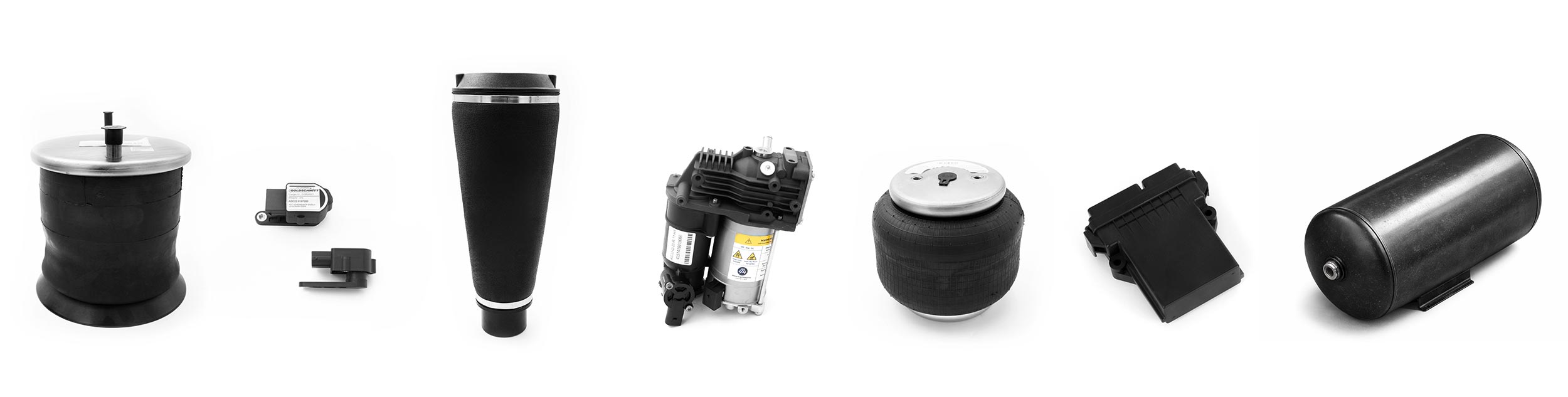
For maximum driving stability, precise level control, and consistently high load capacity, Goldschmitt full air suspension systems rely on the precise interaction of high-quality components. Robust air bellows, precise sensors, a reliable air supply, waterproof connectors, and optimally matched wiring harnesses form the technical foundation. Development and testing are carried out to the strictest quality standards, with a particular focus on safety, durability, and functional reliability. All hardware components are designed for high load capacity and lasting precision. From the air bellows to the compressor, valve technology, and sensors, every component is precisely matched to the overall system. The result is a high-performance chassis with great stability and perceptible comfort that performs reliably even under demanding conditions. The design of the components is largely guided by the respective system concept: In 2-channel systems, the air suspension is typically fitted at the rear axle — ideal for vehicles with high or variable rear loads. 4-channel systems, on the other hand, integrate additional components at both the front and rear axles, providing noticeably greater driving stability and comfort — particularly with varying loads or in dynamic driving situations.
Air Bellows – the load-bearing elements
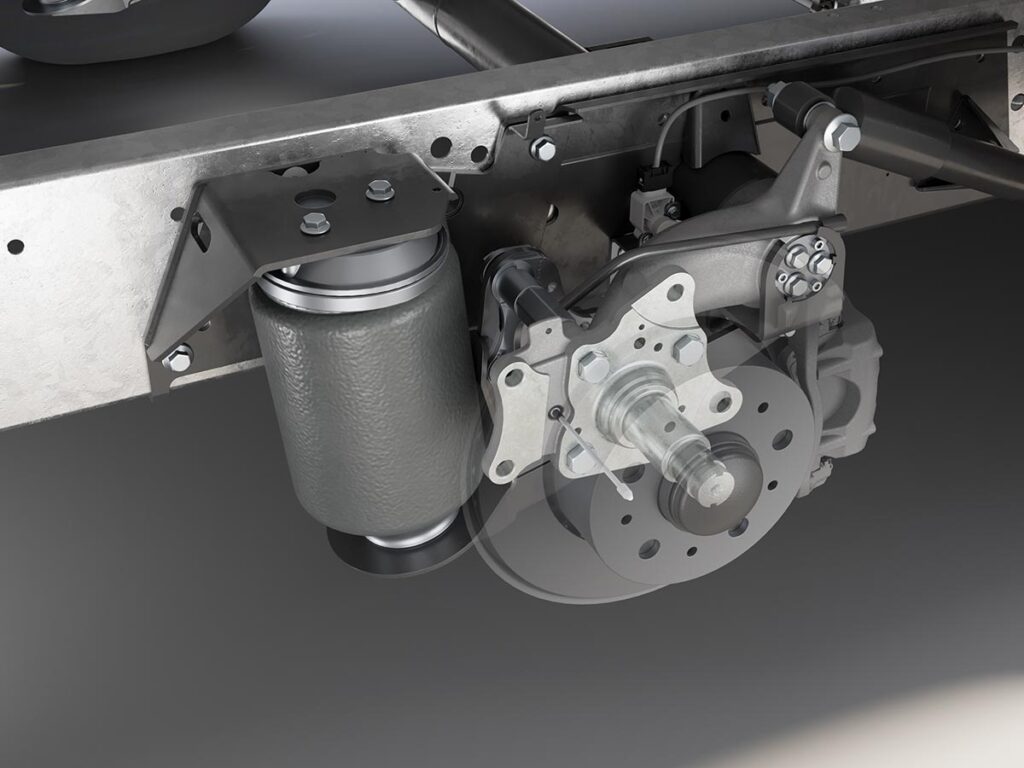
At the heart of the full air suspension are the air bellows. They completely replace the standard steel springs and take over the load-bearing function in the chassis. Depending on the vehicle type, stroke, spring force, available space, and technical requirements, different bellows types are used, which differ in shape, construction, and spring characteristics. Rolling or convoluted bellows are most commonly used; their special geometry and large air volume enable particularly sensitive suspension. The design ensures even load distribution and stabilises the vehicle even under heavy loads or on uneven road surfaces. At the same time, the spring characteristics are tuned to minimise rebound oscillation. This coordinated bellows technology forms the foundation of our full air suspension systems and ensures controlled and comfortable driving behaviour. In addition, double convoluted bellows are used, which are particularly robustly constructed and, thanks to their flat design, can be optimally integrated even in confined installation spaces. They are used primarily where little installation space is available or where high additional loads must be reliably absorbed.
Air Supply – compressed air on demand
To ensure the air springs can operate optimally at all times, a powerful compressor generates the required air pressure. Unlike auxiliary air springs, the air is not fed directly into the bellows but is first stored in a large-volume air reservoir. This means the air required for corrections or level adjustments is available particularly quickly, allowing the system to provide the appropriate spring force promptly in any situation. The robust design of the compressor unit enables reliable continuous operation, while integrated drying systems prevent moisture from entering the air circuit. The air reservoir acts as a buffer, relieving the compressor, extending its service life, and ensuring that the ride height remains stable even with frequent adjustments or varying loads.
Sensors – the basis for precise control
To enable the automatic level control to operate with precision, each air bellows in our full air suspension systems is equipped with a separate level sensor. The sensors continuously measure the distance between the vehicle frame and the axle, providing the basis for all control processes. Movements of the suspension cause a rotational movement of the sensor arm, which is proportionally converted into an electrical signal. This signal is transmitted to the control unit (ECU), which then controls the valves of the valve block so that the air bellows are selectively inflated or deflated. In this way, the system adjusts the vehicle height in real time — both fully automatically in response to varying loads and during deliberate manual interventions, such as when loading or unloading or to compensate for a lean.
Valve Technology – precise air distribution
The valve technology forms the centrepiece of the full air suspension and controls the airflow between the compressor, air reservoir, and the individual air bellows. Based on the signals from the level sensors, the control unit (ECU) selectively opens or closes the respective valves, so that air reaches its destination quickly and precisely. Through this coordinated interaction of sensors and valve control, the vehicle height is continuously regulated and an even load distribution is ensured. The compact design of the valve blocks enables space-saving integration, while their high sealing integrity ensures constant pressure retention. This is how Goldschmitt air suspension systems operate reliably and responsively — even under demanding conditions.

For standard and AL-KO chassis.
Tailored suspension solutions for a wide range of vehicle platforms.
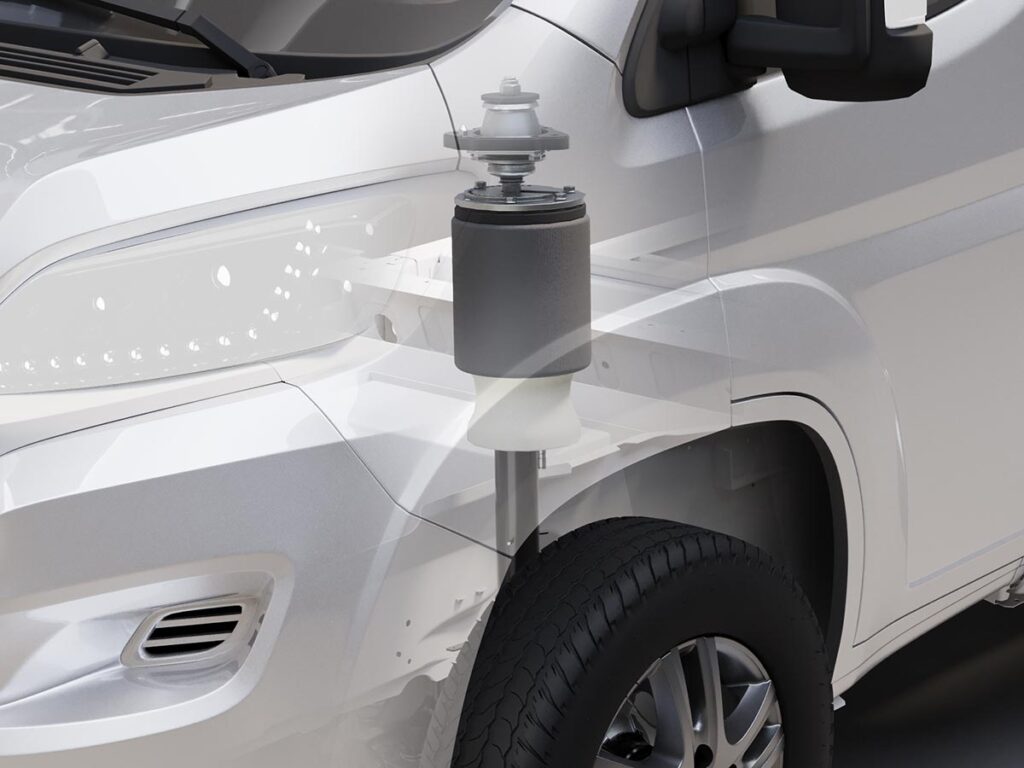
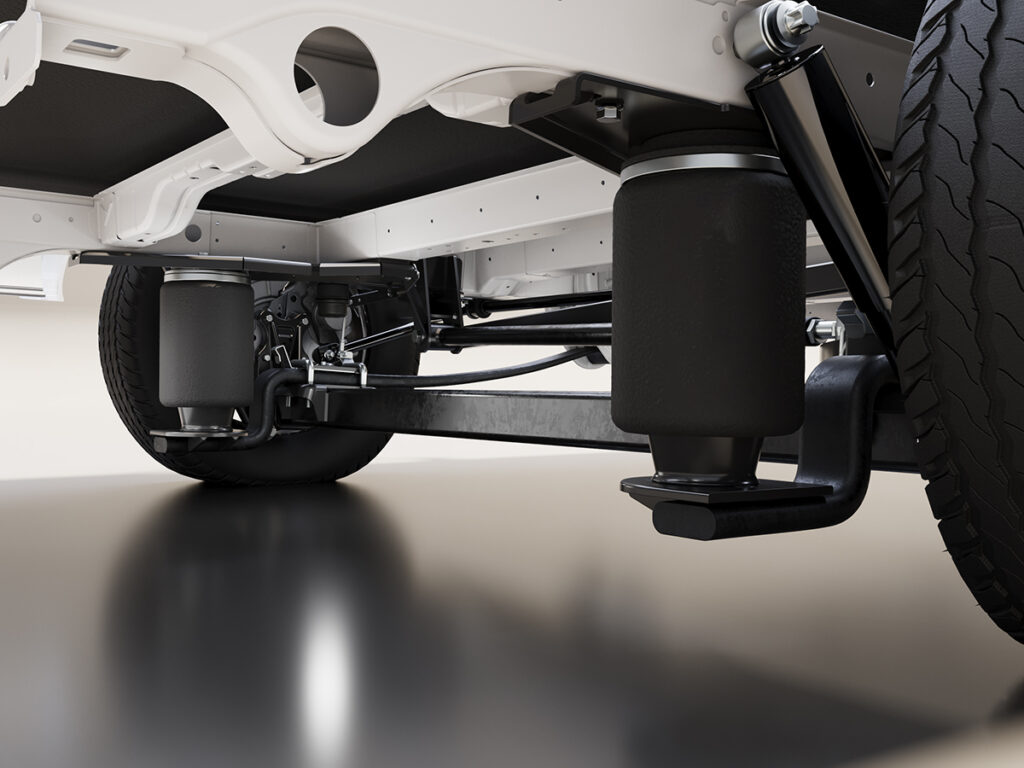
Goldschmitt full air suspension systems are available for the front and rear axles depending on the vehicle model and are precisely matched to the respective chassis design. The focus is not only on integration into the vehicle, but above all on the targeted improvement of suspension, ride comfort, and driving stability. On Ducato vehicles, comfortable rolling bellows at both the front and rear axles ensure a particularly well-balanced and responsive ride: road imperfections are absorbed far more effectively, impacts are noticeably reduced, and the vehicle sits more steadily on the road. At the front axle (Image 1), the air bellows are integrated in an airtight seal around the shock absorber unit, acting directly on the spring movement. At the rear axle (Image 2), they work in conjunction with the wheel-guiding trailing arms, enabling even load distribution and a stable vehicle attitude — even under high or varying loads. A particularly innovative technical solution is the air suspension for torsion bar-sprung AL-KO axles (Image 3). Here, specially developed bracket designs in combination with convoluted bellows that move in an arc enable a harmonious spring movement despite the constructional characteristics of this axle type. The result is a noticeably improved suspension response with high driving stability and precise level control. The outcome is a ride that effortlessly compensates for road imperfections, reduces body roll, and offers a high degree of control and comfort even in demanding road conditions. This complex design combines technical expertise and engineering at the highest level.
Quality and safety set the benchmark.
All Goldschmitt air suspension systems undergo comprehensive tests and real-world trials to ensure maximum reliability in everyday use. This includes testing for compatibility with modern electronic safety and driver assistance systems, such as the electronic stability programme (ESP). In addition, all systems are tested for electromagnetic compatibility (EMC). This ensures that the air suspension systems are neither influenced by other electronic components nor cause interference themselves. As a result, our full air springs operate reliably and are unaffected by external influences — even in vehicles with extensive additional electronics — while at the same time not impairing any other systems.