
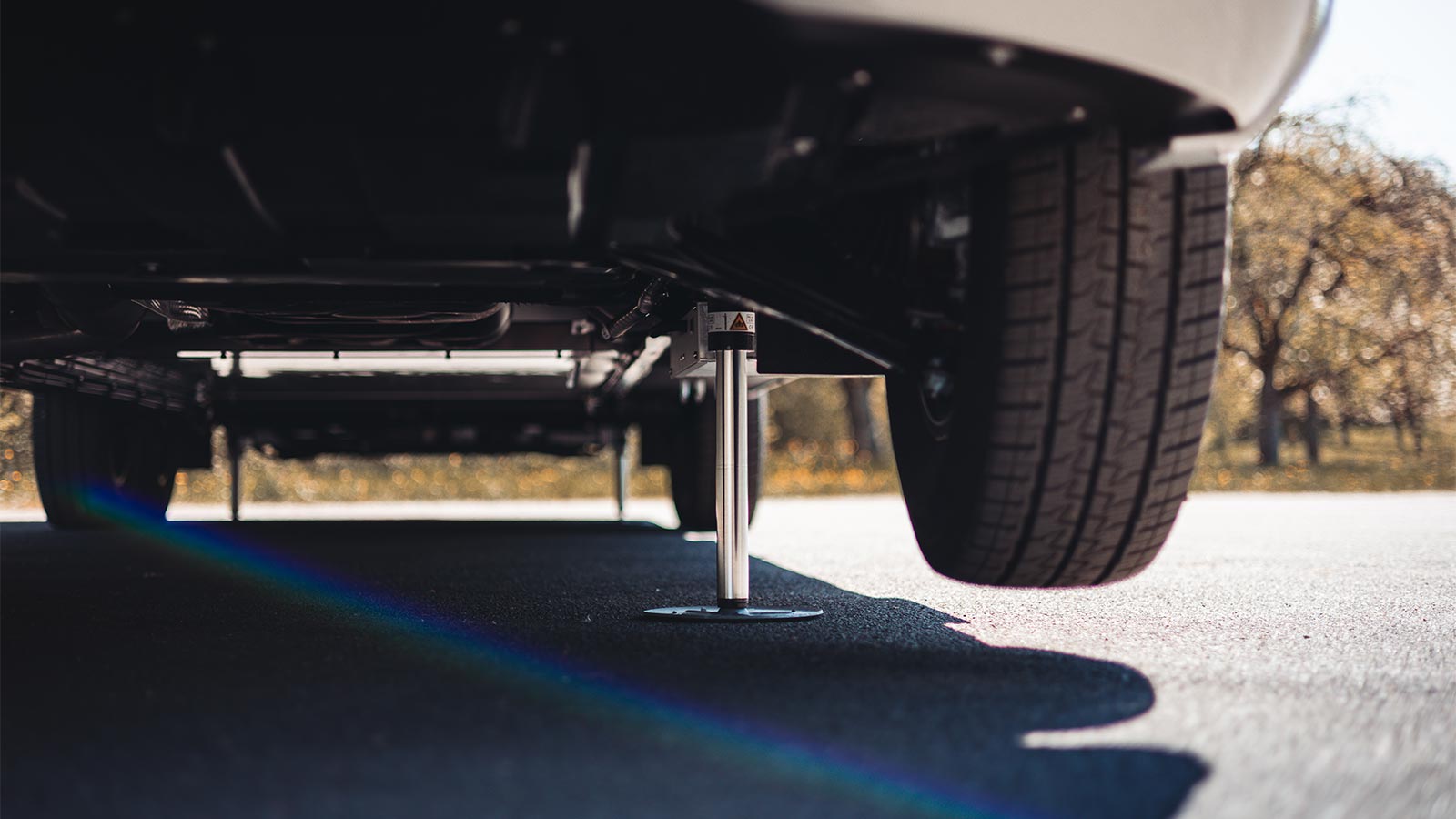
Weight is a central issue for motorhomes—and for many customers, it is a particularly important factor when deciding on hydraulic leveling systems. After all, every single kilogram counts toward the vehicle’s payload capacity. Consequently, those interested in a leveling system often begin by comparing the weights specified by different providers. However, caution is advised here: not all weights are the same.
There are many different hydraulic leveling systems on the market—including our HLC® Smart, as well as numerous other solutions from both well-established and lesser-known manufacturers. Although many of these systems operate on a similar fundamental principle, significant differences emerge in practice—in terms of quality, stability, ease of use, range of functions, serviceability, and actual installed weight. This is precisely why it is worth taking a closer look. While low weight figures may appear attractive at first glance, they are only meaningful if it is clear which components have been included in the calculation—and whether the systems being compared are truly comparable in terms of quality and features.
The reason for this is simple: there are no uniform specifications or binding standards for the weight figures of hydraulic leveling systems. Consequently, each manufacturer is free to define which components are included in the stated weight—and which are not. It is also notable that weights are frequently presented as “starting from” figures. While such values may appear highly attractive at first glance, they typically refer to the lightest theoretical configuration—not necessarily the specific setup actually required for a given vehicle. This creates figures that seem comparable on the surface, but often are not in practice. You should therefore carefully examine what a given weight figure actually encompasses. Does it refer to a 2-jack system or a complete 4-jack system? Are the mounting brackets included? Has the necessary installation hardware been accounted for? Is the hydraulic fluid included in the weight, or is it merely a “dry” weight? And what is the actual capacity of the hydraulic tank being used?
Hydraulic cylinders are another particularly important factor, as their stated weights can vary significantly. Often, very low weight figures refer to the smallest and lightest cylinders within a product series. However, these are not necessarily suitable for every vehicle—in fact, for larger motorhomes, specific body configurations, or higher weight classes, they may not be practical to use at all. Therefore, the decisive factor is not which system is theoretically the lightest, but rather which version is actually appropriate for the specific vehicle in question.
Furthermore, a simple comparison of weight is often insufficient. A hydraulic leveling system is more than just the sum of its kilograms; factors such as quality, stability, technical design, ease of operation, range of functions, serviceability, and suitability for everyday use all play a significant role. A system might appear lighter on paper if it omits certain components, utilizes smaller parts, or features a different configuration of equipment and technical specifications. Ultimately, what matters to you as a customer is not the lowest theoretical figure, but rather a system that is practical, fully installable, and reliably durable within your own vehicle.
At Goldschmitt, we make a conscious effort to communicate the weight of the HLC® Smart in a transparent and practical manner. Because vehicle models, sizes, and weight classes vary, it is not possible to provide a single, universal weight figure for hydraulic leveling systems. For the standard Fiat Ducato chassis, the ready-to-operate weight of the HLC® Smart (4-jack system) is approximately 76 kg, while the dry weight is about 70 kg. This figure includes all components necessary for installation and operation: the hydraulic power unit, the appropriate mounting bracket set for under-vehicle installation, four hydraulic cylinders of the correct design and length, jack mounts, hydraulic hoses, 6.5 liters of hydraulic oil, and the remote control.
Our tip: Don’t just compare the figure provided in the product description. Ask specifically what is included in the stated weight—and what is not. Only a fully assembled, ready-to-install system will reveal the actual weight that will ultimately be installed in your vehicle.